Live Free: Discover the Keys to Living in God's Presence 247 by Dennis Clark & Jen Clark
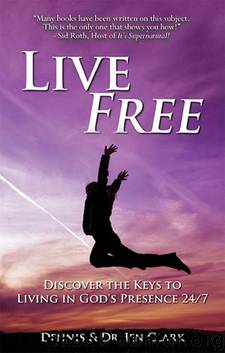
Author:Dennis Clark & Jen Clark [Clark, Dennis]
Language: eng
Format: epub
ISBN: 9780768484649
Publisher: Destiny Image, Inc.
Published: 2013-12-17T05:00:00+00:00
LOCATE OUR THOUGHTS
You think thoughts in your head, of course, but you also have “thoughts” in your heart. Have you ever heard someone describe a “hunch” or “gut” reaction? Have you ever felt a “knowing” in your gut that you couldn’t really explain with your brain? We can often find wisdom when we “go with our gut” when making decisions, relying on more than just logic and analysis.
The validity of “gut instincts” is now proven by laboratory research. Scientists and therapists document that our gut, bowels, or belly region is the place not only of emotion and will, but is also inseparable from cognition or thought. We have feeling-thoughts, or “emo-cognitions.”
Recent research confirms that we have an emotional “brain” in our gut that is as active and important as the brain between our ears. Dr. Michael Gershon calls it the “second brain.”1 Experts in neurobiology and psychotherapy have since defined a new field of research, neurogastroenterology or “enteric neurology.”
Although we have a brain between our ears, God has given us a “second brain” with an equally significant function of cognition in our gut. Have you ever heard anyone use the expression “I know that I know”? There are two places of knowing: the brain between our ears and the second brain, called the “enteric nervous system.”
There are as many neurons in the enteric nervous system as there are in the brain and central nervous system. Millions of neurons line the walls of our esophagus, intestines, stomach, and colon. Our two brains interact by way of the “left vagus nerve,” connecting the emotional center in the brain (the limbic system) directly to the intestines. Neuropeptides, molecules of emotion, are released throughout the body and brain, transmitting emotional information to every cell, organ, and system of the entire body.
We can witness the validity of “gut responses” in a new type of polygraph test. The traditional polygraph assessment collects physiological data from at least three systems in the human body, including respiratory activity, sweat gland activity, and cardiovascular activity. Unfortunately, it is possible to beat a polygraph. There is plenty of information out there teaching people how to do just that.
Dr. Pankaj Pasricha and his team at the University of Texas recently measured nerve activity in the stomachs of volunteers, asking some individuals to lie and others to tell the truth.2 Those who lied were discovered by measuring reactions in the gut. Dr. Pasricha observed, “The gut has a mind of its own. Its nervous system acts independently.” In other words, this is a polygraph system that is completely reliable. In 2008, Dr. Pasricha applied for a patent for a new type of lie detector based on his research.3
Now we can understand why we immediately feel an emotion, often in our belly area, when we think about a painful experience or imagine a hurtful person. Our two “brains” are experiencing the memory at the exact same time. It is as important to attend to the thoughts or images in our head as it is to feel the emotions in our “bowels.
Download
This site does not store any files on its server. We only index and link to content provided by other sites. Please contact the content providers to delete copyright contents if any and email us, we'll remove relevant links or contents immediately.
The 5 Love Languages: The Secret to Love That Lasts by Gary Chapman(9819)
The Space Between by Michelle L. Teichman(6944)
Assassin’s Fate by Robin Hobb(6228)
Wiseguy by Nicholas Pileggi(5795)
Everything Happens for a Reason by Kate Bowler(4746)
Gerald's Game by Stephen King(4659)
Pillow Thoughts by Courtney Peppernell(4287)
A Simplified Life by Emily Ley(4168)
The Power of Positive Thinking by Norman Vincent Peale(4072)
Harry Potter and the Prisoner of Azkaban (Book 3) by J. K. Rowling(3363)
Resisting Happiness by Matthew Kelly(3343)
Girl, Wash Your Face by Rachel Hollis(3284)
Being Aware of Being Aware by Rupert Spira(3280)
The Secret Power of Speaking God's Word by Joyce Meyer(3232)
The Code Book by Simon Singh(3197)
More Language of Letting Go: 366 New Daily Meditations by Melody Beattie(3033)
Real Sex by Lauren F. Winner(3026)
Name Book, The: Over 10,000 Names--Their Meanings, Origins, and Spiritual Significance by Astoria Dorothy(2989)
The Holy Spirit by Billy Graham(2957)
